Which Stability Shoe Is Right For You?
Both the Adrenaline GTS 25 and Glycerin GTS 23 use Brooks' GuideRails support, but they ride very differently, and we're breaking down exactly why, plus where the rest of the Glycerin range fits in.
What Does "GTS" Actually Mean?
GTS stands for Go-To-Support. In Brooks' range, it signals a shoe built with GuideRails technology rather than a traditional medial post. GuideRails sit along the outer edges of the midsole and only engage when your foot rolls further than it should, either inward or outward. Runners with a fairly neutral gait won't notice them at all. Runners who overpronate get a gentle nudge back into alignment without the stiff, corrective feel of older stability shoes.
Both the Adrenaline and Glycerin ranges offer a GTS version. The core difference between the two shoes comes down to cushioning volume, weight, and ride feel, not the support system itself.

Brooks Adrenaline GTS 25: Structured Support for Daily Miles
The Adrenaline GTS 25 is Brooks' long-running stability shoe, now in its 25th version. It's built on DNA LOFT v3 foam with a 37mm heel and 27mm forefoot stack, giving a 10mm drop. That's down from the 12mm drop that defined the Adrenaline for years, and it makes the transition from heel to toe noticeably smoother than in past versions.
Weight sits at roughly 10.6oz (300g) for men's and 9.5oz (269g) for women's, putting it firmly in daily trainer territory rather than the max-cushion category. The ride is moderately cushioned and leans firm compared with the Glycerin, which is exactly what makes it work well across a wide range of paces, from easy recovery runs to tempo efforts. It also comes in wide and extra-wide fits, which matters if standard-width shoes leave your feet feeling squeezed by mile six.
Who it suits: New-to-running 5K starters who want a dependable first stability shoe, commuters clocking daily miles on pavement, and half-marathon or marathon runners who need one shoe that copes with both easy and faster sessions.
Brooks Glycerin GTS 23: Maximum Cushioning, Same Support Logic
The Glycerin GTS 23 takes the plush end of Brooks' range and adds GuideRails support on top. It runs on DNA Tuned foam, a dual-density midsole that's softer under the heel and firmer through the forefoot, and sits on a 38mm heel and 30mm forefoot stack for an 8mm drop.
At around 10.8oz (306g) for men's and 9.8oz (277g) for women's, it's heavier than the Adrenaline GTS 25, and that extra weight buys you noticeably more cushioning underfoot. This is not a shoe built for speed sessions or race day. It's built for the runner who wants every easy mile and every long, slow Sunday run to feel as soft and forgiving as possible, while still getting gentle correction if their gait needs it.
Who it suits: Marathon and ultra runners logging high weekly mileage who want extra protection on tired legs, half-marathon improvers doing the bulk of their training at conservative paces, and general fitness runners who prioritise comfort over feedback from the road.
Adrenaline GTS 25 vs Glycerin GTS 23: The Numbers
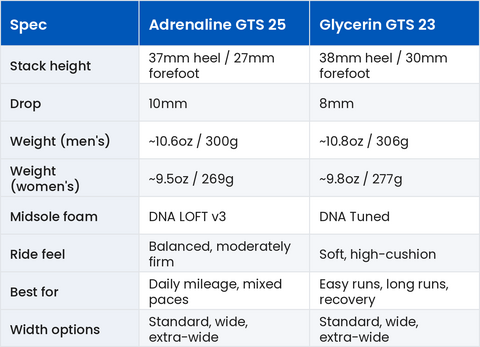
The short version: the Adrenaline GTS 25 is the more versatile, slightly firmer everyday shoe. The Glycerin GTS 23 is the plusher option built specifically for comfort over long, easy efforts. Runners often keep an Adrenaline for regular training and add a Glycerin GTS for their longest runs of the week.
Is the Adrenaline GTS 25 the Same as the Glycerin GTS 23?
No. They share the same GuideRails support technology, but they use different midsole foams, different stack heights, and different drops. The Adrenaline GTS 25 rides firmer and lighter, while the Glycerin GTS 23 rides softer and heavier. Think of the Adrenaline as the do-everything stability shoe and the Glycerin GTS as the comfort-first stability shoe for easy and long miles.

Meet the Rest of the Glycerin Family
The Brooks Glycerin GTS 23 isn't the only Glycerin on the shelf. Brooks builds three other versions around the same soft, high-cushion platform, minus the GuideRails.
Brooks Glycerin 23 (Neutral)
This is the Glycerin GTS 23's neutral sibling. Same 38mm/30mm stack and 8mm drop, same DNA Tuned foam, but without GuideRails, and around 6g lighter per shoe. If your gait doesn't need stability support but you love the plush feel of the Glycerin platform, this is the one to pick. It suits marathon and ultra road racers who want cushioning on tired legs without any guidance built into the ride.
Brooks Glycerin Max 2
The Glycerin Max 2 pushes cushioning further still, with a 45mm heel and 39mm forefoot stack and a lower 6mm drop. At around 11oz (320g) for the men's shoe, it's the heaviest shoe in the family, and it's a neutral shoe with no GuideRails. This is Brooks' answer to runners who want the softest possible landing for recovery days, long runs, or all-day wear off the road, where the extra stack height takes pressure off tired legs and feet.
Brooks Glycerin Flex
Built specifically as a women's model, the Glycerin Flex trims things down again: a 36mm heel and 30mm forefoot stack, a 6mm drop, and a weight of around 8oz (227g) , noticeably lighter than any other shoe in the Glycerin range. Extra flex grooves through the forefoot give a more natural, unrestricted toe-off. It suits time-pressed urban commuter runners and general fitness runners who want Glycerin-level comfort without the bulk of the Max 2 or the structure of the GTS.
What Should Beginners Look for in a Stability Running Shoe?
New runners often assume "stability shoe" means a stiff, corrective shoe. In Brooks' current range, that's no longer true. GuideRails only activate when your foot needs it, so a beginner with mild overpronation can wear the Adrenaline GTS 25 or Glycerin GTS 23 and simply get a smoother, more supported ride, without any harsh correction.
Which Brooks Running Shoe Should You Actually Buy?
Here's a simple way to decide:
- Want one shoe for everything, from easy runs to faster sessions? Choose the Adrenaline GTS 25.
- Want maximum comfort for long runs and recovery days, with support built in? Choose the Glycerin GTS 23.
- Know you're neutral but love a soft ride? Choose the Glycerin 23.
- Want the softest possible landing for recovery miles or all-day comfort? Choose the Glycerin Max 2.
- Want a lighter, more flexible Glycerin built for women's feet? Choose the Glycerin Flex.
- Need wide or extra-wide fitting? Both the Adrenaline GTS 25 and Glycerin GTS 23 come in wide and extra-wide options.
The Bottom Line
The Adrenaline GTS 25 and Glycerin GTS 23 share Brooks' GuideRails support system but deliver very different rides. The Adrenaline is lighter, firmer, and built for daily mixed-pace training. The Glycerin GTS is softer, heavier, and built for comfort on long or easy runs. Beyond the GTS pair, the Glycerin 23, Glycerin Max 2, and Glycerin Flex give neutral runners the same plush platform in three different weights and stack heights.
If you're still not sure which one matches your gait, book a gait analysis appointment at your local Runners Need store and try them on for yourself.
Related Articles


Let us know you agree to cookies
We use marketing, analytical and functional cookies as well as similar technologies to give you the best experience. Third parties, including social media platforms, often place tracking cookies on our site to show you personalised adverts outside of our website. We store your cookie preferences for two years and you can edit your preferences via ‘manage cookies’ or through the cookie policy at the bottom of every page. For more information, please see our cookie policy.