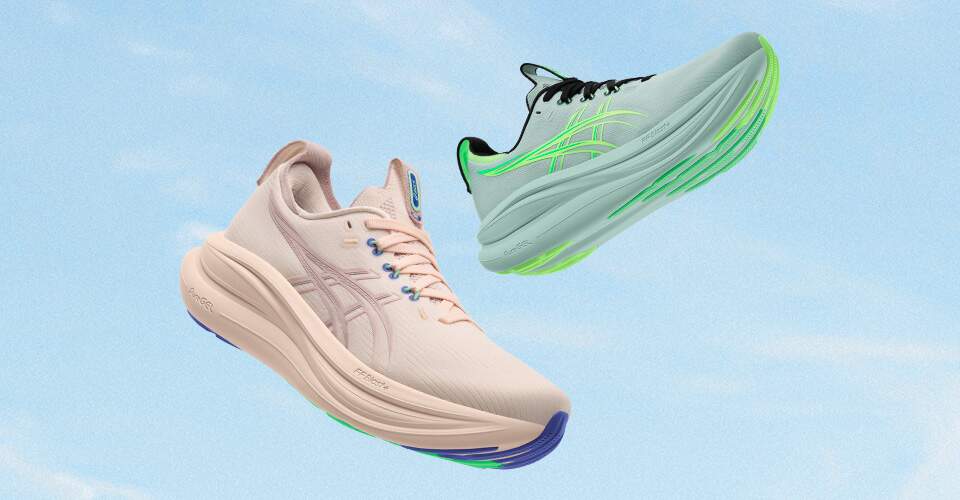
The Asics Gel-Cumulus and Asics Gel-Nimbus look like close relatives, and they are. Both are neutral running shoes built for everyday road miles. Both use an 8mm drop and a PureGEL heel insert. Both series launched in 1999. Yet the two shoes ride very differently, and the wrong pick can leave you with a shoe that feels too firm on long runs or too heavy on quick ones.
The difference comes down to two things: how much foam sits under your foot and how lively that foam feels. This guide puts the Cumulus and Nimbus through five head-to-head rounds, then matches each shoe to the runner who gets the most from it.
Gel-Cumulus and Gel-Nimbus Differences
The Asics Gel-Nimbus has more cushioning. Its heel stack (the thickness of foam under your heel) is 43.5mm, against 38.5mm on the Asics Gel-Cumulus. Asics rates the Nimbus as maximum cushioning and the Cumulus as high cushioning. The Gel-Cumulus is lighter at 259g (9.1oz) against 281g (9.9oz) in men's sizing, and it uses Asics' more energetic FF BLAST MAX foam. Choose the Nimbus for long, slow miles. Choose the Cumulus for a lighter shoe that covers most of your week.

Gel-Cumulus and Gel-Nimbus Similarities
Before the rounds begin, here is what the two shoes share:
A neutral shoe has no built-in guidance for overpronation, which is when the foot rolls inward more than usual. Runners who overpronate strongly should look at stability shoes instead.
Drop is the height difference between the heel and the forefoot. An 8mm drop sits in the middle of the range, so switching between these shoes rarely needs an adjustment period.
Asics says PureGEL is around 65% softer than its standard GEL. The insert sits in the heel to soften each landing.
Both shoes grip tarmac and pavement well, and both carry reflective details for dark mornings and evenings.
Both shoes are built for easy and steady runs rather than racing.
Five Rounds: Gel-Cumulus vs Gel-Nimbus
Round 1: Softness and Impact Protection
The Nimbus stands 43.5mm tall at the heel and 35.5mm at the forefoot in men's sizing. Stack height is the total thickness of the sole between your foot and the ground. The Cumulus measures 38.5mm and 30.5mm.
That 5mm gap adds up over thousands of footsteps. Asics rates the Nimbus as maximum cushioning. Runners with sore legs after long weekend runs often notice the extra foam first.
Winner: Gel-Nimbus
Round 2: Weight
The Cumulus weighs 259g (9.1oz) in men's sizing, and the Nimbus weighs 281g (9.9oz). That 22g (0.8oz) gap is about the weight of a AA battery on each foot. Lighter shoes feel easier to lift on quicker runs, and the difference shows most in the final miles.
Recent updates have trimmed weight from the Nimbus. That narrows the gap between the two shoes.
Winner: Gel-Cumulus

Round 3: Bounce and Pace
The Cumulus uses FF BLAST MAX foam, which Asics describes as one of its most energetic midsole materials. Foam energy is the amount of spring the midsole gives back after each step. The Nimbus uses FF BLAST PLUS, a plusher foam with more of it underfoot.
Some reviewers describe the Nimbus as firmer and snappier than its plush reputation suggests. For most runners, though, the Cumulus still feels livelier at steady and moderate paces. Strides and tempo efforts (comfortably hard running) suit the Cumulus better.
Winner: Gel-Cumulus
Round 4: Long Runs and Marathon Miles
Extra foam matters most when fatigue builds. After 90 minutes on the road, the thicker Nimbus midsole absorbs more impact per step, and many runners find their legs feel fresher afterwards.
Half-marathon and marathon training blocks often include a weekly long run of two hours or more. The Nimbus is built for that job. The Cumulus handles long runs too, although some reviewers describe it as firmer than the Nimbus over very long distances.
Winner: Gel-Nimbus
Round 5: Everyday Flexibility
Plenty of runners own one pair of running shoes. That pair needs to handle an easy jog, a steady run and the occasional faster session. The lower, lighter Cumulus copes with that mix more easily than the taller Nimbus.
A taller stack sits further from the ground, which can feel less steady on tight corners and uneven pavements. The Nimbus can still do a bit of everything, but its high stack rewards a slower, smoother rhythm.
Winner: Gel-Cumulus
Final score: 3-2 to the Cumulus. The score matters less than which rounds match your week.

Gel-Cumulus vs Gel-Nimbus: The Numbers
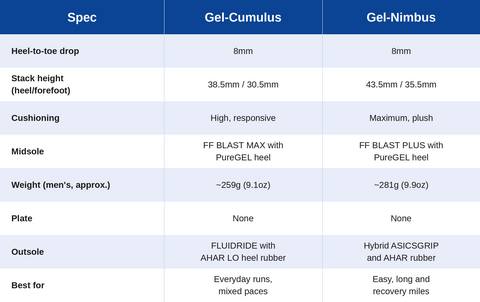
Figures are for men's sizing. Women's versions sit about 1mm lower in stack height and weigh less.
The Gel-Nimbus is the softer, more protective option built for long and recovery miles. The Gel-Cumulus is the lighter, livelier shoe built to cover a wider mix of paces.
Which Runner Are You?
Choose the Gel-Cumulus if you are:
- A new-to-running 5K starter who wants a lighter, easy-to-live-with first shoe with plenty of cushioning.
- A time-pressed urban commuter runner who mixes quick run-commutes with easy evening jogs.
- A half-marathon improver adding a couple of quicker sessions to each training week.
- A performance-driven club runner who wants a cushioned trainer for easy days between harder efforts.
- A hybrid or Hyrox athlete, or a general fitness runner, who runs between gym sessions. The lower stack tends to feel closer to the ground.
Choose the Gel-Nimbus if you are:
- A marathon or ultra road racer logging big weekly mileage and wanting maximum protection underfoot.
- A half-marathon improver who runs long on Sundays and wants soft landings for two hours or more.
- A general fitness runner who wants a plush shoe for recovery days and easy jogs.
- A new runner whose legs feel sore in the first weeks of training and who wants extra padding.
A note for trail runners: Neither shoe suits mud, roots or steep descents. Beginner trail explorers who stick to towpaths and cycle paths can use either one. Mountain and fell runners should browse trail running shoes instead.
The Three-Question Test
Still undecided? Answer these three questions in order:
- How long is your longest run? If it usually lasts under an hour, lean towards the Cumulus. If it regularly passes 90 minutes, lean towards the Nimbus.
- Do you want one shoe or two? One shoe for everything points to the Cumulus. A second pair for long runs points to the Nimbus.
- What feels better to you: soft or springy? Soft and plush points to the Nimbus. Light and lively points to the Cumulus.
If your answers split, try both on in store. A few laps of the shop floor tell you more than a spec sheet.

Can You Run in Both? A Simple Weekly Rotation
Many runners use two pairs of shoes to match the shoe to the run. Here is an example week for a half-marathon improver:
- Tuesday: easy 5 miles on pavements in the Cumulus.
- Thursday: steady 6 miles with a few faster minutes in the Cumulus.
- Sunday: 10-mile long run on a canal towpath or park loop in the Nimbus.
The Cumulus handles the quicker, shorter runs. The Nimbus protects your legs when the miles pile up.
The Quick Recap
The Gel-Nimbus wins on cushioning and long-run protection. The Gel-Cumulus wins on weight, bounce and everyday flexibility. Both shoes are neutral daily trainers with an 8mm drop and a PureGEL heel. Pick the Nimbus if long runs shape your week, and pick the Cumulus if you want one lighter shoe for most of it.
Shop the Gel-Cumulus and Gel-Nimbus at Runners Need, or book a gait analysis appointment at your local store to try both on before you decide.
FAQs
The Nimbus earns its place if you run long regularly or want the softest ride in the Asics neutral range. Runners who mostly run 5K to 10K distances may find the Cumulus gives them everything they need in a lighter shoe.
Yes. The Gel-Cumulus has high cushioning, an 8mm drop and a neutral fit. This combination suits most new runners building up from their first 5K. New runners who feel sore in the early weeks can also consider the Nimbus for extra padding.
The Gel-Nimbus suits most marathon training blocks because its thicker midsole protects tired legs on long runs. Many marathon runners keep a lighter shoe, such as the Cumulus, for shorter sessions. Racers chasing a fast time should also look at race and lightweight shoes.
No. Both shoes are neutral. Runners whose feet roll inward strongly should look at Asics Gel-Kayano or Asics GT-2000, which are Asics stability shoes.
Yes. Runners often pair a lighter shoe for weekday runs with a more cushioned shoe for the long run. The shared 8mm drop makes swapping between the two feel natural.
Related Articles

Let us know you agree to cookies
We use marketing, analytical and functional cookies as well as similar technologies to give you the best experience. Third parties, including social media platforms, often place tracking cookies on our site to show you personalised adverts outside of our website. We store your cookie preferences for two years and you can edit your preferences via ‘manage cookies’ or through the cookie policy at the bottom of every page. For more information, please see our cookie policy.