
Which One Should You Buy?
If you're deciding between these two Saucony running shoes, you're not alone. Both sit in Saucony's everyday running range, both use PWRRUN+ cushioning, and both look similar enough on a shelf to cause genuine hesitation. But they're built for different feet and different jobs.
What's the Difference Between the Saucony Ride and Guide?
The Ride is Saucony's neutral daily trainer. In its latest version it has an 8mm heel-to-toe drop, a PWRRUN+ midsole, and a soft, bouncy ride designed for runners with a natural, balanced footstrike. The Guide is Saucony's stability trainer. Its latest version has a 6mm drop, Center Path technology built into the midsole geometry, and a firmer, more structured feel designed to guide the foot through each stride.
Put simply: the Ride cushions, and the Guide supports. Neither shoe is "better." They solve different problems for different runners.

Cushioning and Ride Feel
The Ride uses a PWRRUN+ midsole that Saucony has reformulated to run lighter and softer, with more energy return underfoot. Runners who've tested it report a springy, forgiving feel, particularly through the forefoot, which makes it well suited to easy runs, long runs, and daily mileage where comfort matters more than snap.
The Guide takes a different approach. Its midsole is a compression-moulded PWRRUN (EVA) foam, paired with a PWRRUN+ sockliner for a layer of softness closer to the foot. The result is a ride that's protective and smooth rather than lively. It's less about bounce and more about control, particularly on longer runs and recovery days when your form starts to break down.
Support and Stability: What Does "Center Path" Actually Mean?
Center Path is Saucony's name for the Guide's stability system. Instead of a hard plastic post (the old-school way stability shoes worked), Center Path uses a combination of higher sidewalls, a broader base, and asymmetric foam density to keep your foot centred through the gait cycle. It nudges your stride back toward a neutral path rather than forcing a correction.
This matters if you overpronate, meaning your foot rolls inward more than average after it lands. Overpronation itself isn't a problem to fix at all costs, but for some runners it's linked to knee, shin, or arch discomfort over high weekly mileage. Roughly one in three runners shows some degree of overpronation when assessed on a treadmill, according to gait analysis data commonly cited by physiotherapists and running shops, though that doesn't mean a third of runners need a stability shoe. Many run without issue in neutral trainers regardless of foot mechanics. A shoe like the Guide is built to reduce that inward roll without feeling like it's fighting your natural movement.
The Ride has no stability structure. It's designed for runners whose stride pattern is already close to neutral, letting the foot move through its natural range without added guidance.
Fit and Upper Comparison
Both shoes use an engineered mesh upper, and both fit true to size for most runners. The Ride adds extra heel collar padding for comfort on longer efforts. The Guide goes a step further with a memory foam collar, designed to lock the heel in place, which matters more in a stability shoe where foot movement is being actively managed.
Neither shoe runs notably narrow or wide compared to Saucony's usual fit, though the Guide's structured sidewalls can feel slightly snugger through the midfoot. If you're between sizes or have wider feet, it's worth trying both in-store before deciding.
Weight and Drop: The Numbers Side by Side
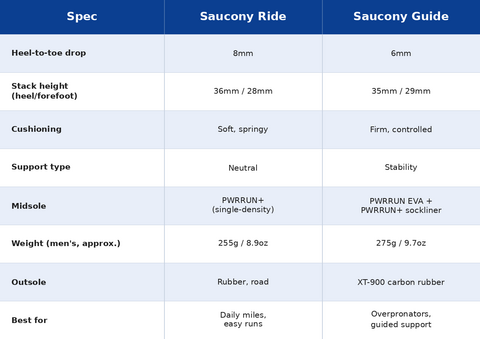
The Guide is around 20g heavier per shoe in a men's size than the Ride, which is typical for stability trainers carrying extra structure in the midsole. The lower 6mm drop also shifts slightly more load to the calf and Achilles compared with the Ride's 8mm, so if you're switching from a higher-drop shoe, expect a short adjustment period. Heel-to-toe drop measures the height difference between the heel and forefoot of a shoe rather than the total cushioning, which is why two shoes with very different stack heights can still share the same drop figure.
What About the Saucony Guide TR GTX?
The Saucony Guide TR GTX takes the Guide's stability platform and builds it for rougher ground. It keeps Center Path technology and a PWRRUN midsole, so the guided, controlled ride stays familiar. What changes is the outsole and upper. A PWRTRAC outsole with 3.5mm lugs replaces the road-only tread, giving grip on gravel, mud, and loose trail surfaces that a standard road outsole would struggle with. A Gore-Tex Invisible Fit upper adds waterproofing, keeping water out through puddles and wet grass while still allowing some breathability.
This isn't simply a waterproof version of the road Guide. It's built for runners who move between pavement and light trails and want one shoe that handles both without changing stride feel. Sizing runs about half a size small, so most runners do better going up half a size from their usual fit.

Who Should Buy the Saucony Ride?
The Ride suits runners who don't need stability features and want a comfortable, do-it-all daily trainer. That includes:
- New-to-running 5K starters building a base without foot pain or gait issues
- Half-marathon and marathon runners who want a dependable shoe for easy and long runs
- General fitness runners who want one shoe for the gym, the treadmill, and the road
- Time-pressed commuter runners who want reliable cushioning without overthinking the choice
If you've never been told you overpronate, or you've run happily in neutral shoes before, the Ride is the safer starting point.
Who Should Buy the Saucony Guide?
The Guide suits runners who benefit from extra guidance through the stride. That includes:
- Runners who've been assessed as overpronators during a gait analysis or fitting
- Half-marathon improvers who log high weekly mileage and want added support on tired legs
- Runners recovering from previous overuse issues linked to excess inward foot roll
- Anyone who's previously worn a Saucony stability shoe (Guide, Omni, or Hurricane) and wants to stay in the same family
If you're unsure whether you overpronate, a free gait analysis assessment at a specialist running shop is the most reliable way to find out, rather than guessing from shoe wear patterns alone.

Who Should Buy the Saucony Guide TR GTX?
The Guide TR GTX suits the same overpronating runner as the standard Guide, plus a specific need: routes that mix pavement with towpaths, parkland, or light trail. Beginner trail explorers who still want stability, and commuter or club runners training through wet winter mornings, are the clearest fit. If your mileage stays on dry roads, the standard Guide breathes better and costs less. If you never touch trail, the lugged outsole is more grip than you need.
The Bottom Line
The Ride and Guide share the same DNA but solve different problems. The Ride is Saucony's neutral, cushioned daily trainer, built for runners whose stride doesn't need extra guidance. The Guide is the stability option, built for runners who overpronate or want a firmer, more structured ride on daily road miles, and the Guide TR GTX carries that same support onto wet roads and light trails with a lugged outsole and waterproof upper. All three share engineered construction and Saucony's PWRRUN family of foams, but the way each shoe supports your foot, and the ground it's built to cover, is where they genuinely differ.
Book a gait analysis appointment at your nearest Runners Need store to find out which of these three fits your stride.
FAQs
Yes. The Guide is built specifically for mild to moderate overpronation, using Center Path technology to guide the foot rather than forcing a hard correction. It's not designed for severe overpronation, which may need a more structured motion-control shoe instead.
Yes. It uses a Gore-Tex Invisible Fit membrane in the upper, which blocks water from getting in while still allowing some breathability. Combined with a lugged PWRTRAC outsole, it's built to handle wet roads, puddles, and light trail conditions in the same run.
They can, but it's not the ideal match. The Guide's structured midsole is built around correcting inward foot roll, so a neutral runner may find the ride feels firmer and less lively than the Ride. If you don't overpronate, the Ride will generally feel more natural underfoot.
It can help. The Guide's firmer midsole and Center Path stability limit excess foot movement, which may ease strain on the arch. It's not a treatment for plantar fasciitis, so persistent heel or arch pain is worth checking with a podiatrist or physio, and a shop fitting can confirm if a stability shoe suits your foot.
No. The Ride is a neutral shoe with no stability features, built purely for cushioning and energy return. If you need support for overpronation, the Guide is the better choice.
Related Articles

Let us know you agree to cookies
We use marketing, analytical and functional cookies as well as similar technologies to give you the best experience. Third parties, including social media platforms, often place tracking cookies on our site to show you personalised adverts outside of our website. We store your cookie preferences for two years and you can edit your preferences via ‘manage cookies’ or through the cookie policy at the bottom of every page. For more information, please see our cookie policy.