Two Neutral Trainers, Two Very Different Rides
The Ghost and Glycerin both sit in Brooks' neutral, cushioned line-up, and both are built for runners without a pronounced pronation issue. Past that, they part ways fast. The Ghost is the firmer, lighter daily trainer that's carried Brooks' reputation for two decades. The Glycerin trades some of that firmness for noticeably more foam underfoot. Here's what actually separates the two, plus where the wider Ghost and Glycerin families fit in.
Same Brand, Different Job
Both shoes are neutral, meaning neither has built-in support for runners who overpronate (where the foot rolls inward more than it should through the stride). If you need that kind of guidance, Brooks pairs the Glycerin with a GTS version, while the Adrenaline GTS plays that role alongside the Ghost.
The real split comes down to foam and stack height. The Ghost runs on DNA Loft v3, a nitrogen-infused foam tuned for a firmer, more consistent feel underfoot. The Glycerin uses DNA Tuned, a softer, dual-density foam with bigger air cells under the heel for cushioning and smaller ones under the forefoot for a quicker push-off. More foam means more weight, so the Glycerin also carries roughly an extra 10-15g per shoe. That's the trade-off in a sentence: the Ghost stays closer to the ground and feels more responsive, while the Glycerin sits higher and feels softer at the cost of a little pace.

Brooks Ghost: Built to Rack Up Miles Without Fuss
The Brooks Ghost runs a 36mm heel and 26mm forefoot stack, giving a 10mm drop, and weighs around 10.2oz (289g) for men's and 9.2oz (260g) for women's. That drop is on the higher side for a modern trainer, which suits heel strikers particularly well.
A Segmented Crash Pad through the outsole smooths the transition from landing to toe-off, and high-abrasion rubber in the contact zones keeps the shoe holding up over hundreds of miles. The upper uses breathable engineered mesh with generous ventilation, and the shoe is available in narrow, standard, wide and extra-wide fits, useful if regular-width shoes feel tight by mile six.
Who it suits:
- New-to-running 5K starters who want a dependable first shoe without paying for cushioning they don't need yet
- Time-pressed urban commuters who want one reliable shoe for easy runs and faster efforts alike
- Half-marathon improvers building weekly mileage on a budget-friendly daily trainer
- Performance-driven club runners who want a firmer, more direct ride than a max-cushion shoe
What it's not built for: the softest possible landing. If your priority is maximum protection on tired legs during a long training block, the Glycerin will feel more forgiving.
Brooks Glycerin: Maximum Comfort for Every Easy Mile
The Glycerin 23 runs a taller 38mm heel and 30mm forefoot stack for an 8mm drop, and weighs around 10.6oz (300g) for men's and 9.6oz (272g) for women's. That's roughly an extra 10-15g in the men's shoe compared with the Ghost, all of it spent on cushioning.
The DNA Tuned midsole is genuinely one of the softer foams in Brooks' range, and the dual-cell structure means the heel absorbs impact while the forefoot still returns a reasonable amount of energy at toe-off. A triple jacquard warp knit upper wraps the foot in extra padding around the heel collar and tongue, and a redesigned outsole layout is built for better grip on wet roads.
Who it suits:
- Marathon and ultra road racers who want extra protection for the final miles of a long run
- General fitness runners and gym-goers who spend a lot of time on their feet and want comfort first
- Runners managing niggles such as plantar fasciitis who benefit from a softer landing
- Anyone doing the bulk of their training at conservative, easy paces
What it's not built for: speed sessions. The extra foam and weight make the Glycerin feel noticeably less lively than the Ghost when you pick up the pace, so most runners reach for it on easy days and long runs rather than tempo work.
Ghost vs Glycerin: Spec for Spec
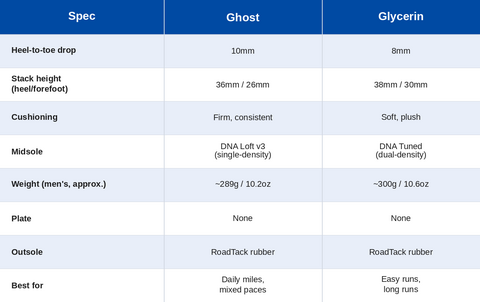
The Ghost is the lighter, firmer, more budget-friendly option. The Glycerin adds roughly half an ounce of foam and a softer ride in exchange.
Where the Rest of the Range Fits In
Neither shoe is the only option in its family. If the Ghost feels too firm, too low, or not quite right for the terrain, and the Glycerin isn't giving you what you need, Brooks has five more places to look.
Brooks Ghost Max
The Ghost Max takes the Ghost's reliable ride and adds significantly more foam, with a 40mm heel and 34mm forefoot stack on a lower 6mm drop. It suits runners who want the Ghost's dependable feel but with a taller, more protective platform underfoot.
Brooks Ghost Amp
The Amp swaps the Ghost's DNA Loft v3 for DNA HYPE, a springier nitrogen-infused PEBA and EVA blend, paired with new SpringRamp forefoot geometry designed to add extra pop at toe-off. It runs a 36mm heel and 30mm forefoot stack on a 6mm drop and weighs around 9oz (255g) for men's, noticeably lighter than the standard Ghost. It suits club runners and Hyrox athletes who want a livelier, more propulsive version of the Ghost ride for faster sessions.
Brooks Ghost Trail
The Ghost Trail takes the road-focused Ghost's DNA Loft v3 cushioning off-road, adding a TrailTack Green rubber outsole with 3mm lugs for grip on gravel and packed trails, plus 3D-printed toe overlays for extra protection against roots and rocks. Stack sits around 36mm heel and 28mm forefoot on an 8mm drop, with weight around 10.6oz (300g) for men's and 9.6oz (272g) for women's. It suits beginner trail explorers who want the Ghost's familiar ride with enough grip for mixed terrain, without stepping up to a dedicated technical trail shoe.
Brooks Glycerin GTS
Built as a support running shoe, the GTS shares the Glycerin's DNA Tuned midsole but adds GuideRails support, firmer strips built into the sidewalls of the midsole that gently correct the foot only when it rolls further than it should. It suits runners who love the plush Glycerin ride but need mild stability guidance.
Brooks Glycerin Max
Built to push the Glycerin cushioning further still, with a 45mm heel and 39mm forefoot stack on a 6mm drop. It's the heaviest shoe in the family at around 11oz (311g), built for runners chasing the softest possible landing on recovery days or long runs off the road.
Brooks Glycerin Flex
The Glycerin Flex trims the standard Glycerin down to a lower 36mm heel and 30mm forefoot stack on a 6mm drop, and weighs around 8.8-9.1oz (249-258g) for men's and 8oz (227g) for women's, noticeably lighter than the Glycerin 23. Asymmetrical flex grooves through the midfoot let the shoe bend more naturally through the stride. It suits time-pressed urban commuters and general fitness runners who want Glycerin-level cushioning in a lighter, more flexible package.
How Each Shoe Feels Once You're Running
Numbers on a spec sheet only tell half the story. Step into the Brooks Ghost and you'll notice it sits closer to the ground than most current daily trainers. The firmer DNA Loft v3 foam gives a stable, grounded platform rather than a bouncy one, and the higher 10mm drop places more cushioning under the heel, which heel strikers tend to appreciate. It's not the plushest ride on the market, but that firmness is exactly why it copes well across a wide range of paces without feeling sluggish.
The Brooks Glycerin feels noticeably different from the first step. The taller stack and softer DNA Tuned foam create a plusher, more cushioned sensation underfoot, particularly through the heel. Reviewers consistently describe the ride as smooth and forgiving, with the firmer forefoot cells keeping toe-off from feeling mushy despite all that extra foam. It rewards a steady, comfortable pace rather than surges in effort, which is why long-run and recovery-day miles suit it best.

New to Neutral Running Shoes? Start Here
A neutral shoe simply means the midsole has no built-in correction for overpronation, so it's the right starting point for most runners unless a gait analysis flags otherwise. Beginners often assume more cushioning automatically means more comfort, but that isn't always true. Too much stack height can feel unstable for runners still building strength and balance, while too little can feel harsh on early runs.
The Ghost is a solid first shoe for exactly this reason: enough cushioning to protect the legs without the height or weight of a max-cushion trainer. Runners who find their legs sore after runs, or who are stepping up weekly mileage quickly, often prefer the extra protection the Glycerin provides instead.
Quick Pick: Ghost or Glycerin?
- Want one shoe for daily miles and faster sessions, at a lower weight? Choose the Ghost.
- Want the softest ride possible for easy runs and long-distance training? Choose the Glycerin.
- Need wide or extra-wide fitting? The Ghost offers the widest range of widths.
- Dealing with niggles like plantar fasciitis? The Glycerin's extra cushioning tends to suit sore legs and feet better.
- New to running and not sure where to start? The Ghost gives a balanced, budget-friendly introduction without the extra height of the Glycerin.
The Ghost and Glycerin both come from Brooks' neutral range, but they're built for different days on your training plan. The Ghost is the lighter, firmer option that copes with almost anything you throw at it. The Glycerin is the plusher, more protective shoe built for comfort over pace.
If you're still not sure which one matches your stride, book a gait analysis appointment at your local Runners Need store and try both on before you decide.
FAQs
Both work, but for different reasons. The Ghost copes well across a full training block, from easy runs to faster sessions, while the Glycerin is better suited to the easy and long-run days that make up most marathon mileage. Some runners keep a Ghost for regular training and add a Glycerin for their longest weekly run.
Both fit true to size for most runners, according to current reviews. The Glycerin's plusher upper and padded heel collar give a slightly snugger feel around the ankle, so if you're between sizes, trying both on in-store is the safest way to confirm fit.
Both work well for walking, and Brooks markets each as suitable for road running and walking alike. The Glycerin's extra cushioning tends to suit longer days on your feet, which is why it's a common pick for shift workers and anyone standing or walking for hours at a time. The Ghost still offers enough protection for regular walks, so the choice often comes down to whether you prefer a firmer, more grounded feel or a softer, plusher one underfoot.
No, both shoes fit true to size for most runners. The difference is in volume rather than length: the Glycerin's knit upper has a roomier, more accommodating toebox, while the Ghost's upper holds the foot in a slightly snugger, more secured fit. If you're between sizes in either shoe, trying both on in-store remains the safest way to confirm fit.
The Glycerin's extra cushioning generally suits plantar fasciitis better, since the softer landing reduces the impact felt through the heel with each step. The Glycerin is also compatible with custom orthotics, so runners managing plantar fasciitis with an insert can fit one without losing the shoe's structure. That said, everyone's plantar fasciitis responds differently to cushioning and drop, so it's worth speaking to a podiatrist or physiotherapist alongside trying both shoes in-store.
Related Articles


Let us know you agree to cookies
We use marketing, analytical and functional cookies as well as similar technologies to give you the best experience. Third parties, including social media platforms, often place tracking cookies on our site to show you personalised adverts outside of our website. We store your cookie preferences for two years and you can edit your preferences via ‘manage cookies’ or through the cookie policy at the bottom of every page. For more information, please see our cookie policy.