
Which Blast Family Super Trainer Should You Run In?
Both the Megablast and the Superblast belong to Asics' Blast family of super trainers: shoes built with a high stack of race-inspired foam but no carbon or Pebax plate underfoot. Look at the spec sheet and the two shoes appear almost identical. Both run an 8mm drop, and both stack close to 46mm of foam under the heel. The real difference sits inside the midsole, in how that foam is built and who Asics designed each shoe to serve. Here's how the Megablast and Superblast compare, foam by foam and gram by gram.
What Actually Is a "Super Trainer"?
A super trainer sits between an everyday training shoe and a race-day carbon racer. It borrows the high stack heights and premium foams found in racing shoes, then drops the rigid plate so the ride feels more natural over a full training block. Runners reach for a super trainer when they want race-day energy without paying for it the next morning.
Neither the Megablast nor the Superblast uses a plate. That puts both shoes in the same unplated category, and it's the main reason they read so closely on paper. Asics keeps its carbon-plated Metaspeed range for race day and uses the Blast family, including these two shoes, for training miles that still want some race-day character built in.

Asics Megablast: The Lighter, Firmer Option
The Megablast weighs around 223g (7.9oz) and runs an 8mm drop, with a 46mm stack at the heel and 38mm at the forefoot. The midsole uses a single foam, FlyteFoam Turbo Square, which Asics built for a firmer, more energetic feel than the softer foams used elsewhere in the range.
That firmness comes with a distinct rocker shape. The transition point starts closer to the midfoot than on most trainers, pushing the foot into a quicker toe-off and rewarding a faster cadence. Deep grooves at the heel add flexibility despite the shoe's firmer platform, and a narrower heel and base give the Megablast a more locked-in feel underfoot. The upper is an engineered mesh with ribbed laces and flat eyelets that spread lacing pressure evenly across the foot, and ASICSGRIP rubber covers the outsole for grip on wet or dry roads.
Who it suits:
- Performance-driven club runners who want extra energy for tempo sessions and faster long runs
- Half-marathon improvers building speed without stepping into a fully plated racer
- Marathon and ultra road racers who want a snappier daily trainer between long efforts
- Hybrid and Hyrox athletes who need one shoe that copes with mixed-pace training
The trade-off is comfort at slow paces. The firmer foam and narrower base mean the Megablast doesn't feel as forgiving as the Superblast on easy, low-effort miles, so most runners keep it for sessions where pace matters most.

Asics Superblast: Maximum Cushioning With Added Bounce
The Superblast sits at a near-identical stack to the Megablast, around 46mm at the heel and 8mm at the forefoot with the same 8mm drop, but it weighs slightly more at roughly 239g (8.4oz). That extra weight buys a completely different midsole. Instead of one foam, the Superblast stacks two: FF LEAP sits on top, the same foam Asics uses in its Metaspeed racing shoes, and FF BLAST PLUS sits underneath to add stability and stop the ride from feeling loose.
A new trampoline pod sits in the forefoot outsole, built to add extra spring at toe-off without needing a plate. The upper switches to an engineered woven construction with a gusseted tongue, which locks the midfoot down while staying breathable over longer runs. ASICSGRIP rubber covers the outsole here too, keeping grip consistent between the two shoes.
Who it suits:
- Marathon and ultra road racers who want cushioning that holds up over long training blocks
- General fitness runners and gym-goers who spend a lot of time on their feet and want comfort first
- Time-pressed urban commuters who need one shoe that copes with easy runs, long runs, and the occasional faster session
- New-to-running 5K starters stepping up their weekly mileage and wanting extra protection underfoot
Where the Megablast leans firm, the Superblast leans plush. It's built as Asics' do-it-all daily trainer rather than a speed-first tool.

Same Stack, Different Foam: Why the Ride Feels So Different
Stack height only tells half the story. Two shoes can share the same 46mm of foam and still feel completely different underfoot, and that's exactly what happens here.
The Megablast's single-foam midsole compresses less under load, so more of your effort returns as forward motion rather than getting absorbed into the foam. That's why it rewards a faster cadence: the firmer platform gives you something solid to push against. The Superblast's top layer of FF LEAP compresses further before it rebounds, soaking up more impact on tired legs, while the firmer FF BLAST PLUS base layer stops that softness from turning into instability.
Neither approach is better outright. A firmer, single-foam ride suits runners who want direct feedback from the road. A softer, dual-layer ride suits runners covering long distances who want the shoe to do more of the shock absorption for them.
Megablast vs Superblast: The Numbers
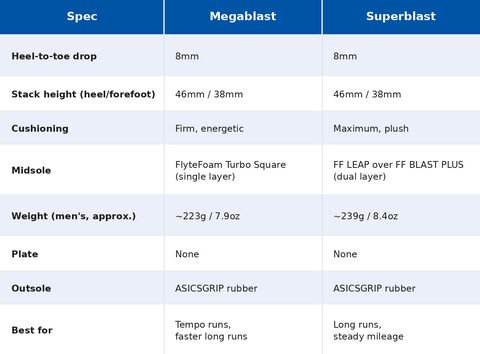
The Megablast is the lighter, firmer shoe built for pace. The Superblast carries a little more weight in exchange for a softer, more cushioned ride across longer miles.
Which Shoe Feels Faster on the Road?
Pick up the pace in the Megablast and the shoe responds almost immediately. The firmer foam and forward rocker work together to push you through toe-off, which is why runners doing tempo sessions or faster long runs tend to reach for it. It doesn't ask for a specific rhythm. It rewards whatever effort you put in.
The Superblast wants more of a steady rhythm to feel its best. The trampoline pod adds real spring at toe-off, but the softer top-layer foam takes a beat to load and unload, so the shoe feels most at home holding a consistent pace over distance rather than surging in and out of effort. Runners moving between easy jogs and quicker sessions in the same week often notice this difference within the first few runs.

Do You Actually Need a Super Trainer?
Not every runner needs a shoe from the Blast family, and it helps to check a few boxes before spending on either model.
- You're running three or more times a week. Super trainers earn their keep across regular mileage rather than the occasional 5K.
- You've already got a comfortable everyday trainer. The Megablast and Superblast work best as an addition to a rotation, not a first running shoe.
- You're training for a specific race. Both shoes give the biggest return during a structured marathon, half-marathon, or 10K block, where the extra energy return adds up over weeks of training.
- You want fewer shoe changes across a training week. A single super trainer that copes with easy runs and tempo sessions can replace two separate pairs for some runners.
New-to-running 5K starters and anyone easing into regular mileage are usually better served by a lower-stack, lower-cost everyday trainer first. Once a consistent weekly mileage base is in place, either the Megablast or Superblast becomes a sensible step up.
How to Choose Between the Megablast and Superblast
Here's a quick way to decide:
- Want a lighter, firmer super trainer built for tempo runs and faster long runs? Choose the Megablast.
- Want maximum cushioning and a plusher ride for long, steady mileage? Choose the Superblast.
- Training for a half marathon or marathon and want one shoe across mixed paces? Both cope well. The Superblast leans easier, the Megablast leans quicker.
- New to super trainers and want the softest introduction to race-derived foam? Start with the Superblast.
- Chasing a personal best in training and want the shoe with the most direct feedback? Reach for the Megablast.
If you're still unsure which ride suits your training, book a gait analysis appointment at your local Runners Need store and try both on before you decide.
FAQs
The Blast family runs wider than just these two shoes. The Novablast sits below both as Asics' everyday trainer, with a lower stack and a softer, more relaxed ride built for daily mileage rather than speed work. At the other end, the Sonicblast adds a non-carbon ASTROPLATE to a dual-foam setup close to the Superblast's, aimed at workouts and faster running rather than long, steady miles.
That puts the Megablast and Superblast in the middle of the range.
No. Asics built the Megablast as a companion to the Superblast, not a replacement for it. Both shoes sit side by side in the current Blast lineup, and Asics designed each one for a different kind of session rather than positioning one as an upgrade over the other. If you already run in the Superblast and love the plush, dual-foam ride, the Megablast won't replace that feeling. It offers something firmer and more speed-focused alongside it.
No. Neither the Asics Megablast nor the Superblast has a carbon plate. Both shoes belong to Asics' Blast family of unplated super trainers, which pair a thick, energetic midsole with a flexible sole rather than a rigid insert. Asics reserves carbon-plated construction for its Metaspeed racing range, keeping the Megablast and Superblast as plate-free training shoes built for everyday miles rather than race day.
Yes, the Asics Superblast fits true to size for most runners. Reviewers testing the latest version report that the redesigned woven upper runs true to size in both men's and women's fittings, with a roomier, higher-volume toe box than earlier Superblast versions, correcting the tighter fit some runners experienced before. The midfoot and heel hold a secure, normal-width lockdown thanks to a gusseted tongue and padded heel collar, so runners between half sizes generally don't need to size up. As with any running shoe, trying a pair on in-store or checking the size guide before ordering is the safest way to confirm fit for your foot shape.
Related Articles

Let us know you agree to cookies
We use marketing, analytical and functional cookies as well as similar technologies to give you the best experience. Third parties, including social media platforms, often place tracking cookies on our site to show you personalised adverts outside of our website. We store your cookie preferences for two years and you can edit your preferences via ‘manage cookies’ or through the cookie policy at the bottom of every page. For more information, please see our cookie policy.