
The Hoka Challenger and the Hoka Speedgoat are both neutral trail running shoes with thick, cushioned midsoles. Both also come in a waterproof GTX version. Beyond those shared traits, the two shoes do different jobs. The Challenger is a road-to-trail shoe built for mixed routes, such as a canal path that turns into a forest track. The Speedgoat is a technical trail shoe built for mud, rock and steep climbs. This guide compares grip, cushioning, fit and weather protection, then matches each shoe to the running you actually do.
Which Hoka Trail Shoe Is Right for You?
Choose the Hoka Challenger if your runs mix pavement, gravel and groomed trail. Choose the Hoka Speedgoat if your runs regularly head onto mud, roots, rock or steep hills.
The cushioning on the two shoes is closer than most runners expect. Grip is what separates them. The Speedgoat has deeper, stickier lugs (the raised rubber studs on the outsole) that bite into soft and slippery ground. The Challenger has shallower lugs that stay smooth and quiet on tarmac.
How to Choose
Picture your usual route as a scale running from pavement to mountain. The further up that scale you run, the more sense the Speedgoat makes.
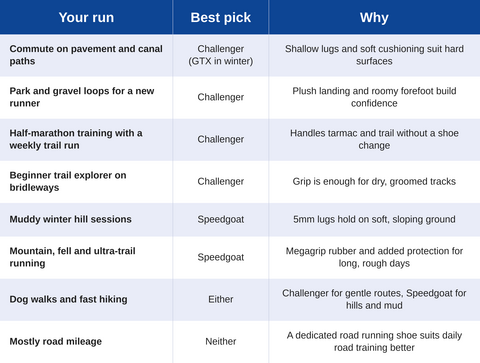
The Challenger wins here. Its shallow lugs wear slowly on hard surfaces and feel smooth underfoot.
Either shoe works. The Challenger feels softer and calmer, while the Speedgoat feels livelier and grips better when the surface turns loose.
The Speedgoat wins here. Its 5mm lugs clear mud and hold on slopes where 4mm lugs start to slide.
The Speedgoat wins again. Its Vibram Megagrip rubber is built for slick rock and technical ground.
Most UK runners sit in the middle of that scale. A Peak District weekend loop, a Surrey Hills long run or a canal commute can all suit the Challenger. A hilly Lake District long run or a winter trail ultra points firmly to the Speedgoat.
Grip Is the Biggest Difference Between the Two Shoes
Two terms explain most of what follows. Stack height is the amount of foam between your foot and the ground. Drop is the height difference between the heel and the forefoot.
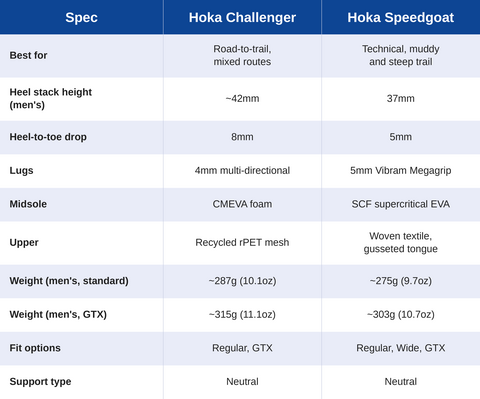
The Challenger has a men's stack of around 42mm at the heel and 34mm at the forefoot, with an 8mm drop. The midsole uses Hoka's CMEVA foam, a compression-moulded EVA that gives a soft, plush landing. An early-stage Meta-Rocker, a curved sole shape that helps the foot roll forward, keeps the ride smooth on firm ground. Hoka added more foam than the previous version had, so the shoe now feels softer and more road-like.
The Speedgoat has a men's stack of around 40mm at the heel and 35mm at the forefoot, with a 5mm drop. Its midsole uses SCF EVA, a supercritical foam that is lighter and bouncier than standard EVA. The result protects the feet over long distances while still feeling responsive on uneven ground.
In practice, the Challenger feels like a cushioned road shoe with trail grip. The Speedgoat feels like a cushioned trail shoe that stays light. Many heel strikers find the Challenger's 8mm drop easier on the calves. The Speedgoat's 5mm drop sits closer to a midfoot landing.
Similar Cushioning, Different Ride
Grip comes from two things: the depth of the lugs and the rubber compound. The Challenger uses 4mm multi-directional lugs on a Durabrasion rubber outsole. Multi-directional means the lugs point in different directions, so they grip when pushing off, braking and turning. Hoka reshaped the pattern for the new version, and the lugs hold well on gravel, dry dirt and damp grass.
The Speedgoat uses 5mm lugs on a Vibram Megagrip outsole. Vibram is a specialist outsole maker, and Megagrip is a sticky rubber compound known for holding on wet rock and roots. One extra millimetre of lug depth sounds small. On soft ground, 5mm lugs sink in and clear mud more effectively than 4mm lugs.
Deep lugs come with a trade-off. They feel firmer and noisier on tarmac, and they wear faster on long road sections. Runners who spend most of the week on pavement and only sometimes head onto dirt usually get better value from the Challenger.

How Does the Fit Differ?
The Challenger has a roomier forefoot than earlier versions. That extra space suits runners with broader feet and anyone who wants toe room on long mixed-surface days. The upper uses recycled rPET mesh, a breathable fabric made from recycled plastic bottles, and a padded heel collar. A printed toe cap adds light protection from knocks.
The Speedgoat holds the foot more firmly, and its upper is built for rough ground:
- A woven textile upper that stays light and breathable
- A dual-sided gusseted tongue, stitched to both sides of the shoe so stones and grit stay out
- A protective toe bumper for kicks against rock and roots
- A gaiter attachment for clipping on a trail gaiter in mud or heather
- A refined heel collar that sits more gently on the Achilles than earlier versions
Runners with wider feet can choose the Speedgoat in a wide fit. The sizing FAQ below covers how snug the shoe feels.
The Numbers Side by Side
The GTX Versions
Both shoes come in a GTX version. GTX refers to GORE-TEX, a waterproof, breathable membrane. Hoka uses GORE-TEX Invisible Fit, which bonds the membrane directly to the upper. The shoe stays flexible and close-fitting instead of feeling lined or bulky.
The Challenger GTX keeps the road-to-trail ride and adds a waterproof upper. It suits winter commuting, wet towpaths and dog walks along muddy lanes, where standing water and cold spray reach the feet.
The Speedgoat GTX keeps the Vibram Megagrip outsole and swaps in a waterproof upper made with recycled Cordura, a tough woven fabric. Toggle lacing makes the fit easy to adjust with gloves on. It suits cold, wet hill days and winter long runs.
GTX shoes carry three trade-offs:
- Weight: Each GTX shoe weighs roughly 30 to 40g (1.1 to 1.4oz) more than its standard version.
- Warmth: The membrane runs warmer, so summer and long hot runs favour the standard shoes.
- Water entry: GTX only blocks water coming through the upper. A puddle or stream that rises above the collar soaks the foot, and the water then drains slowly.
A simple rule works well. Choose GTX if most of your running happens between October and March. Choose the standard version if you run in warm weather or splash through streams.
Each Shoe Suits a Different Run
Use this table to match each shoe to a real route.
Both Shoes Earn a Place in a Trail Rotation
The Hoka Challenger is the softer, calmer shoe for mixed routes, with an 8mm drop, a roomy forefoot and 4mm lugs that stay smooth on tarmac. The Hoka Speedgoat is the grippier, more protective shoe for rough ground, with 5mm Vibram Megagrip lugs and a secure, trail-ready upper. Each shoe comes in a GTX version for wet UK winters. Your usual surface is the best guide to the right choice.
Book a gait analysis appointment at your local Runners Need store to try both shoes on, or shop the Hoka trail range online.
FAQs
Standard Hoka Challenger and Speedgoat shoes are not waterproof, but both models come in a GTX version that is. The GTX versions use a GORE-TEX Invisible Fit membrane to block rain, puddles and wet grass while letting sweat vapour escape. The standard versions let water in but drain and dry faster. Water can still enter a GTX shoe over the collar, so deep puddles and stream crossings will soak either version. Choose GTX for cold, wet winters and the standard version for summer and warm-weather runs.
Yes, both shoes work well for walking and light hiking. The Challenger suits dog walks, towpaths, forest tracks and long days on mixed surfaces, thanks to its soft cushioning and roomy fit. The Speedgoat suits hillier, muddier and rockier walks, where its 5mm Vibram Megagrip lugs hold on wet ground and its gusseted tongue keeps out grit. Both weigh far less than hiking boots, at around 275g (9.7oz) per men's shoe, which makes them popular for fast hiking. Neither offers the ankle support of a boot, so heavy packs and remote, rough terrain still call for boots.
The Challenger is a good choice for road running. Hoka built it for road-to-trail use, and its 4mm lugs feel smooth on tarmac. The soft, high-stack midsole suits easy and steady miles on hard surfaces. The Speedgoat can handle short road links between trails, but its 5mm lugs feel firmer and louder on pavement, and the outsole wears faster on tarmac. For mostly road mileage, a dedicated road running shoe is the better option.
The Speedgoat is listed as true to size, but the fit is snug. Reviewers often describe the toe box as slightly narrow, and some runners prefer half a size up. Consider going up half a UK size if you sit between sizes, wear thicker socks or run long distances, when feet swell. The wide fit is often a better fix for broad feet than a longer size. The Challenger has a roomier forefoot than earlier versions, so most runners should find their usual size comfortable. Trying both shoes on in store is the most reliable way to settle the size.
Neither shoe is designed to treat plantar fasciitis, which is irritation of the thick band of tissue under the foot that causes heel and arch pain. Some runners with this pain find cushioned, rockered shoes easier to wear, because the soft midsole absorbs impact and the curved sole reduces forefoot bend. The Challenger, with its plush CMEVA foam and 8mm drop, is the softer option of the two. The Speedgoat offers good cushioning, but its snugger fit and uneven terrain place more demand on the foot. Heel or arch pain that lingers should be assessed by a physiotherapist or podiatrist before you choose a shoe.
Related Articles

Let us know you agree to cookies
We use marketing, analytical and functional cookies as well as similar technologies to give you the best experience. Third parties, including social media platforms, often place tracking cookies on our site to show you personalised adverts outside of our website. We store your cookie preferences for two years and you can edit your preferences via ‘manage cookies’ or through the cookie policy at the bottom of every page. For more information, please see our cookie policy.